How Black Box Data (EDRs) Prove Fault After a Truck Accident

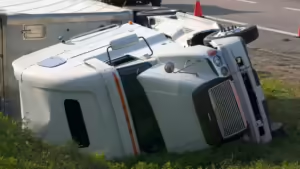
How does a black box or an EDR help to prove fault after a truck accident? Abeyta Nelson attorneys rely on this important tool when gathering case evidence. Call today to learn more.
Truck accidents are rarely simple. Between the size of the vehicles, the number of parties involved, and the layers of federal regulation, figuring out what actually happened can feel impossible. But one piece of evidence often cuts through the confusion, the truck’s “black box,” also known as an Event Data Recorder (EDR).
Black box data doesn’t rely on memory or bias. It records the hard truth. And in Washington truck accident cases, that truth can be the difference between a denied claim and a full settlement.
What Is a Truck’s Black Box?
Much like the flight data recorders used in airplanes, most commercial trucks are equipped with an EDR or electronic control module (ECM). These devices continuously capture detailed information about the truck’s operation in the seconds before, during, and after a collision.
Key data points include:
- Vehicle speed and acceleration
- Brake application and pressure
- Engine RPMs and throttle position
- Steering inputs and lane changes
- Seatbelt use and airbag deployment
- Sudden deceleration or impact forces
- Hours of operation (to check for fatigue violations)
This information creates a second-by-second snapshot of what the truck and driver were doing immediately before the crash.
How Black Box Data Proves Fault
In most truck accidents, the biggest question is who caused it, the driver, the trucking company, another motorist, or all of the above. EDR data provides objective proof.
For example:
- If a driver claims they were traveling within the speed limit, but the EDR shows 72 mph in a 55 zone, liability becomes clear.
- If the trucker says they hit the brakes before impact, but the data shows no braking at all, that statement can be disproven.
- If records reveal the driver exceeded the legal hours-of-service limits, fatigue may have been a contributing factor.
Attorneys and accident reconstruction experts use this data to build a timeline, cross-checking it against skid marks, dashcam footage, and witness statements. Together, these details form a clear narrative of how and why the collision occurred.
Why Acting Quickly Matters
Accessing black box data isn’t automatic. The trucking company controls both the truck and its onboard computer, which means they control the evidence. Unfortunately, that evidence can be overwritten or erased within days.
This is why time is critical. A truck accident lawyer will immediately send a spoliation letter, a legal notice requiring the trucking company to preserve the vehicle and its data. Destroying or tampering with that evidence after receiving notice can lead to severe legal consequences.
If you wait too long, the truck may be repaired, sold, or put back on the road, and with it, the digital proof of what really happened disappears.
Beyond the Black Box: Telematics Data
Modern trucking fleets often use telematics systems, advanced GPS-based tracking tools that record data beyond what’s stored in the EDR. These systems track location, route deviations, speed patterns, and even driver communication logs. When combined with EDR data, telematics can show a complete picture of the truck’s behavior leading up to the crash.
For example, telematics might reveal that a driver ignored dispatch warnings about icy road conditions or that a company pushed its driver to meet impossible delivery deadlines. These patterns of negligence can strengthen your claim and expose broader safety violations.
How Attorneys Use EDR Evidence
Black box data is highly technical and requires professional analysis. Experienced truck accident attorneys work with certified reconstruction specialists who can download, decode, and interpret the data correctly.
Once analyzed, the data helps attorneys:
- Establish clear fault and disprove false claims
- Identify violations of federal safety laws
- Hold trucking companies accountable for negligent supervision or maintenance
- Negotiate stronger settlements with insurance adjusters
- Present irrefutable evidence in court if the case goes to trial
This kind of evidence often leads to early settlements because it leaves little room for dispute. When the data shows negligence, insurance companies know they’re unlikely to win at trial.
Protecting Your Right to Evidence
If you’ve been in a truck accident in Washington, do not assume the black box data will still be there weeks later. Trucking companies are not obligated to keep it indefinitely, and many systems automatically overwrite after a set period.
The best way to protect your right to that evidence is to contact a qualified truck accident lawyer immediately. Your attorney can take quick legal action to preserve the truck, secure the data, and prevent tampering.
Hire Reliable Truck Accident Attorneys in Yakima
In serious truck accidents, black box data can make or break your case. It transforms speculation into proof, showing exactly how fast the truck was going, when it braked, and whether the driver followed the rules meant to keep others safe.
When combined with telematics and accident reconstruction, EDR data gives victims a powerful advantage, the truth, recorded second by second.
If you’ve been injured in a truck accident, contact an experienced Washington truck accident attorney who understands how to secure and use this evidence before it’s gone. Black box data doesn’t lie, but it won’t wait either.
Contact Abeyta Nelson, you don’t pay unless we win.