Understanding Vicarious Liability in Commercial Trucking Accidents

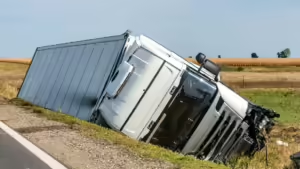
Understanding vicarious liability in trucking accidents can make all the difference in your case. The truck accident experts at Abeyta Nelson can help.
When a commercial truck crashes, the damage is often devastating. Victims face severe injuries, medical debt, and long recovery times. But determining who’s responsible is rarely as simple as blaming the driver. In many cases, the law allows injured victims to hold the trucking company or another party accountable under a legal principle called vicarious liability.
Vicarious liability is one of the most important concepts in commercial trucking law, and understanding it can make the difference between partial compensation and full recovery.
What Is Vicarious Liability?
Vicarious liability is a legal doctrine that holds one party responsible for the actions of another. In trucking cases, it often means a trucking company can be held liable for the negligence of its driver if the crash happened while the driver was performing job-related duties.
This concept is based on the Latin phrase “respondeat superior,” meaning “let the master answer.” If a company benefits from its employee’s work, it also bears responsibility for any harm caused while that employee is doing their job.
In other words, if a truck driver rear-ends another vehicle while making a delivery for their employer, the trucking company may share financial responsibility for the accident.
When Trucking Companies Are Held Liable
To establish vicarious liability, several factors must be proven:
- The driver was an employee or agent of the trucking company: Even if drivers are labeled as “independent contractors,” courts often look at how much control the company has over their work. If the company sets routes, schedules, or safety rules, it may still be treated as an employer.
- The driver was acting within the scope of employment: The crash must have occurred while the driver was performing job-related duties, such as transporting cargo, making deliveries, or driving between assigned locations.
- The accident resulted from negligence or wrongful action: This could include speeding, distracted driving, fatigue, or violating federal trucking regulations.
When these elements align, the company can be held responsible, even if management wasn’t directly involved in the crash.
Why Vicarious Liability Matters for Victims
Trucking companies typically carry far higher insurance limits than individual drivers. That means pursuing compensation from the company can ensure victims recover enough to cover medical bills, lost wages, rehabilitation, and pain and suffering.
Without vicarious liability, injured motorists might be left with minimal compensation, especially if the driver’s personal insurance isn’t sufficient. By holding the employer accountable, victims can pursue the full value of their losses.
Other Parties That May Share Liability
Truck accidents often involve multiple entities beyond the driver and employer. Depending on the facts, other companies may also bear responsibility under similar liability theories:
- Freight brokers and logistics companies: If they negligently hire unsafe carriers or fail to verify compliance with safety regulations.
- Maintenance providers: If improper inspections or repairs led to a mechanical failure, such as brake or tire defects.
- Cargo loaders: If poorly balanced or unsecured loads caused a rollover or jackknife accident.
- Manufacturers: If a defective truck part, like a faulty brake system, contributed to the crash.
Each of these entities may be held accountable for their share of negligence, increasing the potential recovery for victims.
Independent Contractors vs. Employees
Trucking companies often claim their drivers are independent contractors to avoid liability. But courts look beyond job titles to determine the true relationship. Key questions include:
- Does the company control the driver’s routes or delivery schedule?
- Does it require specific uniforms, branding, or procedures?
- Does it dictate how and when the work is performed?
If the answer to these questions is yes, the driver may be legally treated as an employee, making the company responsible under vicarious liability.
Proving Negligence and Building a Case
To hold a company liable, your attorney must prove the driver’s negligence caused the crash and that the company is connected through employment or control. Evidence often includes:
- Driver logbooks and electronic hours-of-service data
- Black box (EDR) data showing speed and braking
- Vehicle inspection and maintenance records
- The driver’s employment agreement and pay structure
- Testimony from company supervisors or dispatch records
This evidence can reveal patterns of unsafe practices, such as pushing drivers to exceed legal drive times or neglecting vehicle maintenance.
Why Legal Help Is Critical
Commercial trucking cases are complex. Trucking companies and their insurers move fast to protect their interests, often deploying investigators and lawyers to minimize their liability. Victims need representation that moves just as quickly to preserve evidence and demand accountability.
An experienced truck accident attorney can:
- Identify every liable party under vicarious and direct liability
- Send preservation letters to secure logbooks, black box data, and maintenance records
- Negotiate with insurance carriers for full compensation
- File a lawsuit if the company refuses to accept responsibility
Need Legal Help for Your Truck Accident?
Vicarious liability ensures that trucking companies can’t escape accountability when their drivers cause harm on the road. It recognizes that employers profit from their fleets and must also answer for the risks that come with them.
If you or someone you love was injured in a commercial trucking accident, understanding who is truly liable is the first step toward justice. With skilled legal guidance, you can hold all responsible parties accountable and secure the financial recovery you need to rebuild your life.
Contact a Washington truck accident attorney today to learn your rights, preserve critical evidence, and pursue the full compensation you deserve.
At Abeyta Nelson, you don’t pay unless we win.